The image generation tools using artificial intelligence are evolving at an accelerated pace, and increasingly offer more possibilities for both designers and visual content creators. I have been testing several options lately, and on this occasion I decided to experiment with the A of Freepik, specifically since free version.
My goal was something very specific and therefore very good test to evaluate the level of visual understanding and detail that this tool can achieve: a 3D illustration of a parrot Pyrrhura hypoxantha young, also known as Yellow-sided Green-cheek Conure.
The challenge: how do we describe it?
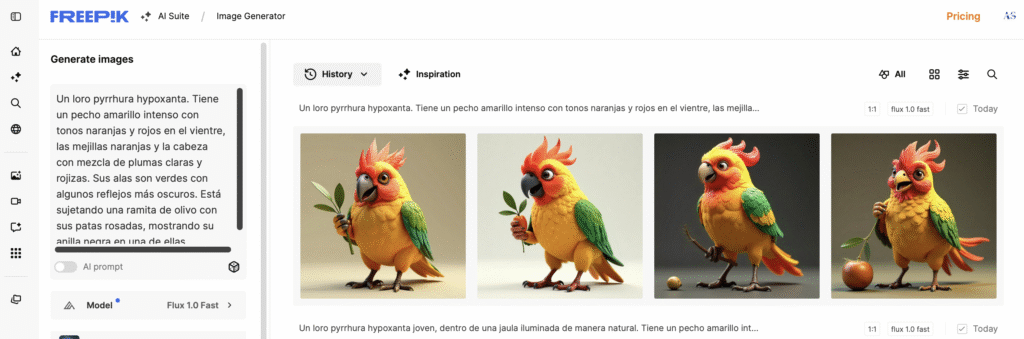
As a first step, I tried to describe the parrot in Spanish in detail, as I would if it were to be dealt with by a professional illustrator. The description was this:
A young pyrrhura hypoxanta parrot, inside a naturally illuminated cage. It has an intense yellow chest with orange and red tones in the belly, orange cheeks and head with a mixture of clear and reddish feathers. Its wings are green with some darker reflections. He's holding an olive bouquet with his pink legs, showing his black ring on one of them. His look is curious and tender, with light beak and slightly sponged feathers. The pose is upright, with a leg raised as it grabs the branch.
The visual response I got was... quite unexpected. Some versions of the parrot looked rather like chickens or rooster, and although 3D style was present, the level of realism or fidelity to the animal was very low.
Improving the description and changing the language of the prompt
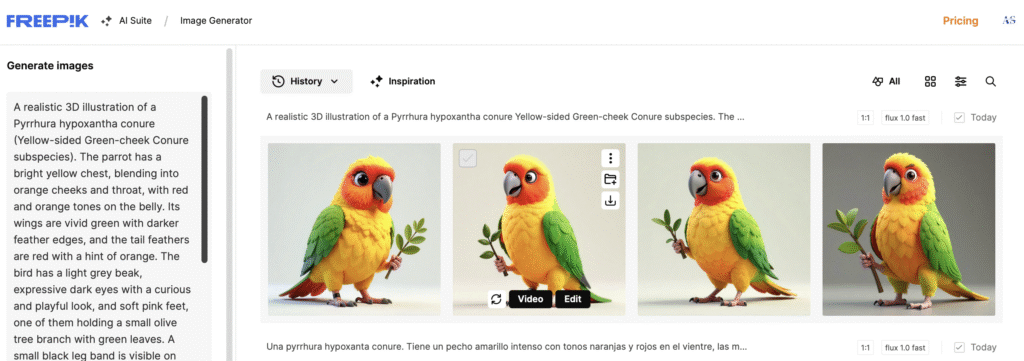
As a designer, I know that prompts are key. So I decided to go one step further: I reformulated the description in Englishwith a technical and visually precise approach. Here's a fragment:
A real 3D illustration of a Pyrrhura hypoxantha conure (Yellow-sided Green-cheek Conure substitutes). The parrot has a bright yellow chest, blending into orange cheeks and throat, with red and orange tones on the beautiful. Its wings are alive green with dark feather edges...
The complete description included details on posture, materials, texture of feathers, expressiveness and visual style (semi-realistic, colorful, detailed, etc.).
And Bingo! The result was much more convincing. For the first time, the IA generated an illustration that really was approaching the mental image of parrot: more realistic proportions, more worked pen texture, living colors and a natural and expressive pose.
What did I learn from this test?
1. Language matters (much)
Freepik AI, as well as other tools based on generative models, responds better to English-language prompts. The level of interpretation and detail was clearly higher.
2. The free version is limited but functional
Although I did not use the premium version, the free version allowed me to play with many parameters such as style, lighting, effect, object location and more. There was no total control, but enough to experience creatively.
3. The level of customization is high (if you know what to ask)
The key is how you describe it. The more precise and technical the prompt, the better results you will get. This makes the tool a valid option for fast-paced or inspiration search.
4. Ideal for conceptual designers
While not replacing the hand of a professional illustrator, it can help you visualize ideas, prototify scenes or even generate visual support material in projects where time or budget are adjusted.
A tool to take into account
This small field test has shown me that Freepik's IA has quite potential, especially if we use it with strategy and criterion. If you are starting to explore generative tools for 3D design or illustration, it can be an interesting option to experience —And even more so if you're interested in working with multilingual prompts or visual A / B tests.
In my case, I will continue to investigate how to make the most of this type of IA applied to creative environments. If you are interested in such tests and practical content, I invite you to continue to connect!

UX / IU Designer and Digital Marketing Specialist
Creating intuitive experiences and effective strategies.