
In the field of UX research, the interviews with users are presented as one of the most powerful tools to understand needs, behaviors and expectations. However, to achieve the best results, it is crucial that you follow a set of steps that optimize the quality of the information collected. Here I leave you a checklistwith the key aspects you must consider to ensure that each interview is effective and provide valuable insights for your project.
Why do you do interviews in an UX investigation?
Interviews in the UX research are an essential tool for obtaining in-depth qualitative information about your users. Here are some of the main benefits of conducting interviews as part of your research process:
- Discovery of hidden needs Users are often not aware of all their needs or cannot articulate them clearly. Interviews allow you to ask questions that discover these hidden needs, giving you a richer and more nuanced understanding of your expectations and desires.
- Contextualization of user behaviour Through interviews, you can understand the context where users interact with your product or service. This context offers you insights into why they act in a certain way and what external factors influence their decisions and behaviour.
- Flexibility and depth in responses Unlike more structured surveys or tests, interviews allow for a flexible flow conversation. You can deepen into specific areas according to the answers of the interviewee and adapt your questions according to what you discover.
- Validation of assumptions Interviews allow you to test your assumptions on users and their behaviour. What you think users need may not match reality, and a well-performed interview may deny or validate your assumptions, allowing you to adjust your design strategies accordingly.
- Empathy and connection to users By listening directly to users, not only do you get data, but you also develop empathy to their challenges and experiences. This emotional connection is key to creating user-centred products that really meet your needs.
Checklist for Effective Interviews in UX Research
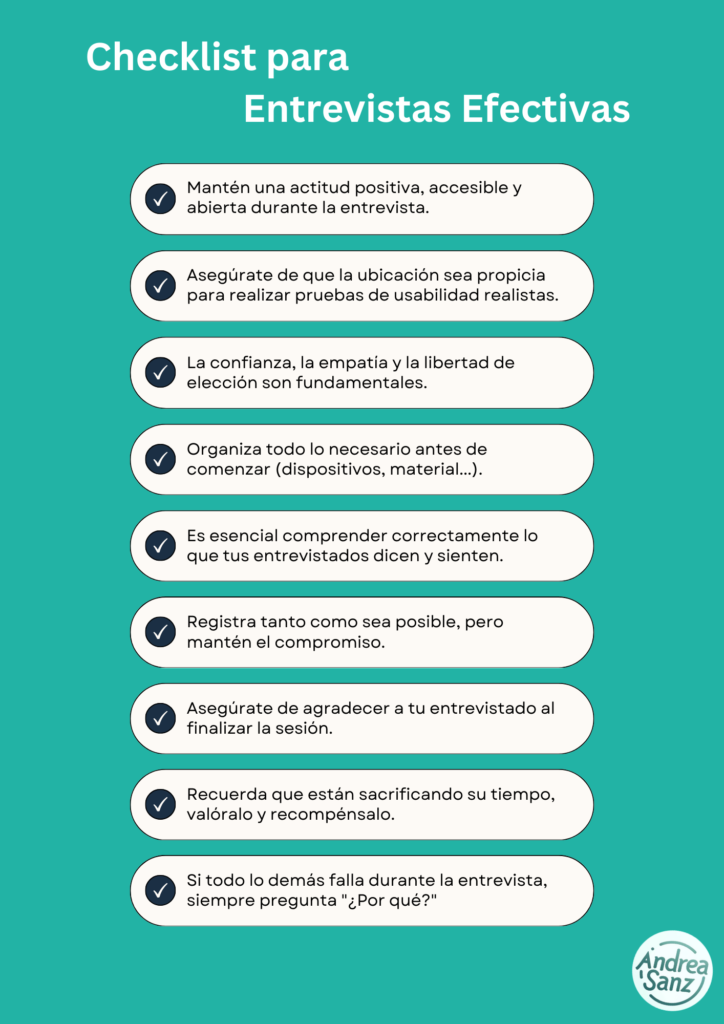
One checklist is a key tool to ensure that no important aspect is overlooked during the research process. In the context of UX research, following a checklist will allow you to structure your interviews efficiently, optimize time with users and get deeper and more valuable insights. Next, we present a detailed checklist that will guide you step by step so that every interview you make is effective and enriching:
- Keep a positive and open attitude during the interview It is essential that you adopt an accessible and receptive attitude. Interviewees must feel comfortable and confident to express their unreserved thoughts and emotions. When the interviewer shows open and active listening, the ideal conditions are created for the user to relax and share sincerely.
- Make sure the location is suitable for realistic usability tests The choice of environment is crucial for the success of an interview. It must be a quiet place, free of distractions, where the interviewees can interact with the products or interfaces under conditions as much as possible to a real use. This ensures that the answers are authentic and reflect the true behavior of the user.
- Empathy and freedom of choice are fundamental During the interview, it is vital that the interviewees feel that they have the freedom to speak and opinion. Avoid questions that may induce a specific or forced response. The empathy is key in this process; understanding the context of the user and his emotions will allow you to ask more relevant questions and get more significant answers.
- Organize everything you need before you start (devices, material, etc.) Preparation is essential. Before you start the interview, make sure you have all the necessary equipment by hand (recorders, prototypes, documents). This step is essential to avoid interruptions and maintain the flow of conversation, maximizing time with the interviewee.
- It is essential to understand correctly what your interviewees say and feel It's not enough to ask questions and listen to answers. You have to make sure understand deeply what the interviewee is communicating, both verbal and non-verbal. Paraphrase your answers to confirm that you have interpreted it correctly and use follow-up questions to deepen in important areas.
- Register as much as possible, but keep the commitment Documenting information is key to not losing important details. It uses audio or video recorders (with the consent of the interviewee) and takes notes during the session. However, do not allow the act of recording to interrupt the conversation or disconnect the interviewee. Keep a balance between getting all the information and following a natural conversation.
- Make sure you thank your interviewee at the end of the session. Participants are investing their time in the research process, so it is essential that you thank them sincerely at the end of the interview. A thank you not only is a courtesy, but it also reinforces the importance of your contribution and leaves a good impression that can foster future collaborations.
- Remember they're sacrificing their time, value it and reward it. Beyond a simple «Thank you.»Make sure the interviewee feels you value his time and effort. If possible, it offers a reward appropriate, such as economic compensation, a free product or service, or even exclusive access to research results. This gesture strengthens the relationship and can improve the quality of future participation.
- If everything else fails during the interview, you always ask «Why?» If you face vague or ambiguous answers, or if you feel that you are not getting the depth you need, one of the most powerful questions you can ask is simply: «Why?». This open question forces the interviewees to reflect and expand their response, which will allow you to obtain deeper and more detailed insights.
Interviews are certainly one of the best ways to understand your users in depth. If you do them right, they'll give you the qualitative information needed to improve your products and services so that they really connect with those who use them. So, follow this checklist and make the most of your UX research interviews.
And here I leave you the checklist in case you want to download it and start practicing!

UX / IU Designer and Digital Marketing Specialist
Creating intuitive experiences and effective strategies.