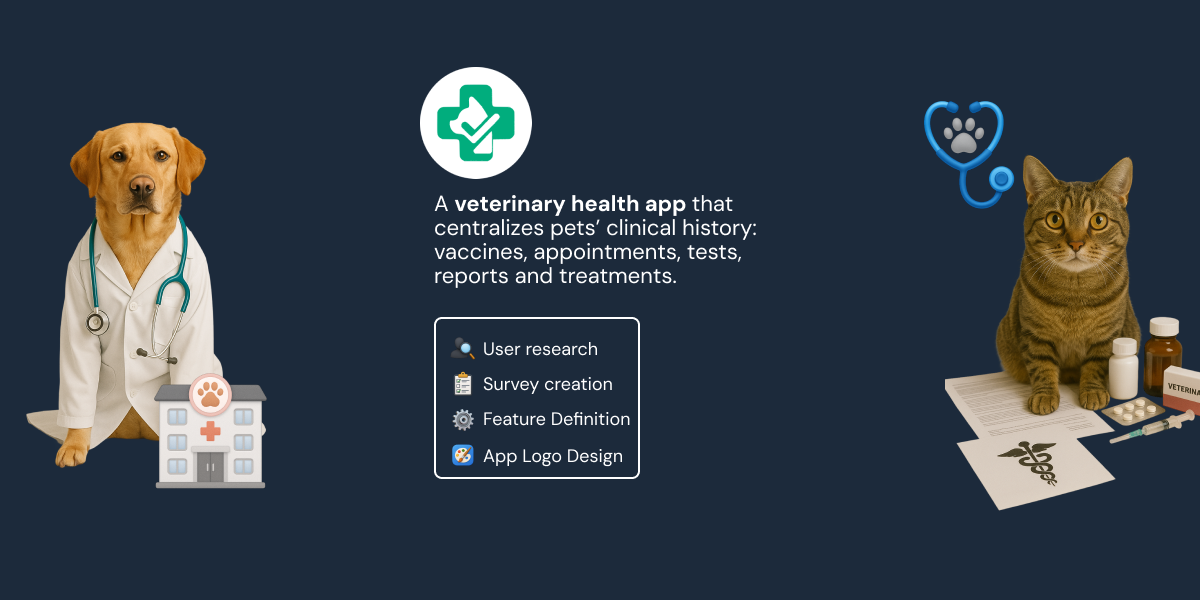
As a designer and human living with animals, I have always been surprised how difficult it is to access the medical information of our pets. Every time you go to the vet, they send you a PDF by mail, or they give you a loose sheet. If you go to different clinics —something quite common when you do external tests or travel—the information is completely fragmented. And if you ever need anything urgent, the most common thing is to have to call for "send it back."
That situation led me to put an idea:
What if there was an app that would centralize the entire medical history of our pets as we do with human health?
Before I started to design anything, I decided to do what any serious project deserves: research, testing and validationif this need was shared. So it's born. Vetify, a UX research project with the aim of discovering how an app could improve the way we manage the health of our animals.
Project objectives
Before designing a solution, I needed to know if the idea made sense, and what aspects were really priority for users. That is why I set these objectives:
- To detect whether there really is a digital need for veterinary medical centralization.
- Understand how people currently manage their pet information.
- Identify the most common pain points.
- Validate the interest in a mobile solution and the most expected functionalities.
- Create Use Real Persons data-based to guide the later design.
UX Research: What I discovered when I spoke to 19 real people
To understand the context, I designed a survey using the Tally.so toolwhich allowed me to collect data in a clear and structured way. Participated 19 pet ownersfrom families living in rural areas with several cats to freelancers in urban environments living with dogs.
Thanks to Tally.so's functionalities —integration with other analysis tools—I could. to extract patterns, segment responses and detect common pain points with more precision. This diversity of profiles was key to building a complete vision of the problem, and allowed me to collect very valuable insights into real habits, frustrations and expectations.
I then detailed the results obtained and how I worked the data of the questions asked.
What kind of pets do they have?
The first questions of the survey were focused on understand what kind of pets the participants hadboth quantity as in typology (species). This helped me identify patterns of tenure and better understand the complexity that can involve managing the health of more than one animal at a time.
Most people surveyed said they had more than one pet, the combination of dogs and cats in the same home. In addition, cases of other animals such as rabbits, ferrets or birds, which extends the range of needs that the app should contemplate.

This diversity of species and experiences led me to point out that the app should allow to create multiple pet profileseach with its individual data (name, species, history, etc.), to respond adequately to the reality of the users.
How do they currently manage the health of their animals?
One of the key sections of the survey was aimed at understanding how users remember important dating such as vaccines, deparasitations or veterinary checks. This part included both open and closed questions to collect a more complete vision.
Most of the responses indicated that the most common method remains the use of paper: from notes in the refrigerator, post-its or notebooks, to physical calendars. Some participants mentioned that use Google Calendar or Excelbut not systematized. Other people are not even clear what to register and when, trusting that the protective, the veterinarian or even a reminder SMS Let him know.

This confirms that, in general, there is a external dependence (veterinary, protective) or one very manual and unreliable management. In addition, a obvious disorganization in the way of archiving analytics, histories or clinical tests, which are usually in PDFs scattered on the mobile or mail.
Then I asked directly if they had ever forgotten any vaccines or treatment. The results were clear:
- The 63% of people He recognized that he had ever forgotten a vaccine or treatment.
- One 26% not sure, which also evidence lack of clear monitoring.
- Only 11% said they never had that problem.

This reinforces the need to create a system that automates reminders and allow control to be carried out without depending on memory, paper or third parties.
Would you use a veterinary app? What functions are you interested in?
We went to a key section of the survey, in which I asked if they currently use any app to manage the health of their animals, with the intention of knowing to what extent they used applications for their pet and for what purpose. The result was even more revealing: 84% do not use any specific application, and only 5% have ever used one. This shows that the market you are not effectively covering this needor that existing solutions are not accessible or practical to the end user.

Although I had already asked if they used any app in general, I wanted to go into it with a more open question: What kind of applications do you currently use related to your pet?. This supplementary question allowed me to understand better why existing options are not working.
The answers were very revealing. On the one hand, several people commented that they don't use apps because they have exotic pets (like hedgehoes or birds) and have found no tools adapted to your case. Only that has already shown an important market vacuum which excludes a part of the users.
On the other hand, those who had tried some app mentioned that they stopped using it because it was not functional or did not meet their real needs. There were no reminders, medical records, or it was just hard to use. Some people preferred to follow WhatsApp or ask the veterinarian directly.

The conclusion is clear: current apps do not provide enough real value or are poorly designed for these profiles. This reinforces the need for Vetify not only to be one more app, but a well-focused, useful and accessible solution for different types of users and pets.
What frustrates them from the current system?
To better understand the shortcomings of the current system I asked three key questions within the survey. Each one allowed me to get a complementary view of the problem:
With the question of «What problem related to your animal care would you like to be able to solve?» I wanted to identify unmet or poorly resolved needs currently. The answers were different, but there were several issues that were repeated:
- Many people need a way to symptoms or behavioural changessuch as loss of appetite, weight or feathers.
- Others need a system that helps them know when acting or consulting the veterinarian, since they feel uncertainty about whether their animals are okay.
- There was also interest in power manage multiple profiles and organize the history of each pet in a clear way.
- Some users even mentioned the possibility of sharing the history with the clinicsomething they can't easily do now.

This reinforces the idea that a good app should not only store databut also accompany the user in decision-making and daily monitoring, without being invasive or complex.
I then proposed to them a closed list of functions to see which ones generated the most interest. The most valued functionality was the health history (47% of replies), followed by automatic reminders (26%) and Medication alerts(21%). The recipe scan was the least voted option (6%).
This confirmed two things to me:
- People need have all concentrated and organised health information.
- There is a real fear of forgetting important things, like a medication or a vaccine, so reminders are a key function.

I assessed that, in addition to storage, users are looking for automation and control on the health of their animals.
I finally asked an open question. spontaneous ideas and real desireswithout guiding the user. The answers were very valuable:
- Some spoke of the need for a community to share doubtsespecially if they have exotic pets.
- Other people asked quick guidance on symptoms, tools for sharing data with family or caregivers, and even options without permanent connection.
- They also mentioned the possibility of download reports to take to the veterinariansomething that would make their lives a lot easier.

This block helped me better understand the real emotions, concerns and expectations of the users. It is not just about managing data, but about feel accompanied, informed and connected with others when they need it.
User People: understand to design better
Once all the data from the survey were analysed, I wanted to go further into the real needs, motivations and frustrations of the users. For this, I used UXPressia, a tool that allowed me to transform the detected patterns into detailed, empathic and actionable profiles.
It was not just about grouping answers, but about give face and context to users, build archetypes that would help me design from reality and not from assumptions. So were three born Use Persons clearly differentiated, each with its history, habits, limitations and way of understanding animal care.
Creating these profiles helped me visualize better to whom the app is addressed and which specific barriers we must solve from design and functionality.
Here I tell you who they are and why they are so relevant to this project.
Marta, 34 years old
Marta represents that kind of user who is used to working with digital toolsbut it has no time or energy to manage another app if it does not bring a real value. He lives with three dogs, he genuinely cares about them and feel guilty when you don't remember a date or lose important information.
Although he has digital knowledge, his problem is not technical, but mental saturation and practical disorganization. He is disturbed by incomplete and unintuitive apps. He needs a solution that works. without thinking, without getting complicated and without having to go in every day to check whether or not something is going right.
What does Marta need from the app?
- A clear and direct interface, without unnecessary steps.
- Total automation of reminders.
- One place to see everything quickly.
- Trust nothing will be lost or overlooked.

Jordi, 29
The rational, visual and demanding profile with the experience.
Jordi works from home, shares the custody of his dog and organizes his life around the mobile. It's a user. very visual, very practical and very conscious of the design. It uses tools constantly, but only if they are well solved.
It bothers you to depend on paper and needs everything to be digitized and accessible in seconds. In addition, by sharing responsibilities with your partner, you appreciate that there may be synchronization between shared profiles or permissions.
What does Jordi de Vetify expect?
- An app well designed visually, with clear hierarchy and smooth navigation.
- Immediate access to the health history from the mobile.
- Possibility of sharing information with other caregivers.
- Let everything work without friction: no confused menus, no overload.

Lucia, 51
The traditional care profile, with technological barriers.
Lucia lives in a rural area with her husband and four cats. Although organized and committed to the care of your animals, technology has always been a challenge to you. It often depends on your grandchildren to install or understand new apps, and any complex interface makes her leave.
His motivation is emotional: he wants to do it right, not forget anything, and have the peace of mind that his cats are well cared for. It values simplicity above anything, and is frustrated when an app is too specialized or thought for more advanced users.
What should Vetify offer to Lucia?
- A simple navigation, no technicalities.
- Clear, visual explanations without unnecessary steps.
- That I can use it without relying on others.
- A design that inspires confidence, without abrupting it.

Working with these profiles allowed me to always keep in mind three different approaches to animal care: the digital saturated, the demanding practice and the traditional caregiver. They all agree on something: they want to take better care, but they need tools that fit their reality, not the other way around..
Design with empathy: more than an app, a care tool
This project has taught me that before you design, you have to listen. That what sometimes seems just a practical problem —like looking for an analytic or remembering a vaccine— It's actually loaded with emotions, insecurities and desire to do it well.
I've learned that the key is to design a tool that accompany, not abrume. Make a contribution control without complexity, and can be used by both an app designer and a cat-loving grandmother.
And above all, that when a solution touches a real needpeople feel it right away. Vetify is still in the research phase, but it has already begun to achieve its purpose.
UX / IU Designer and Digital Marketing Specialist
Creating intuitive experiences and effective strategies.